

We are thrilled to announce the winners of the 2026 Levant Summer Prize!
Launched in 2022, CBRL’s international peer-reviewed journal Levant offers two annual prizes for Best Paper and Early Career Best Paper, which recognise excellent research and scholarship on the archaeology and history of the Levant region, its diasporas and neighbouring countries (prehistory–Ottoman).
For more about the aims and scope of Levant, please see here.
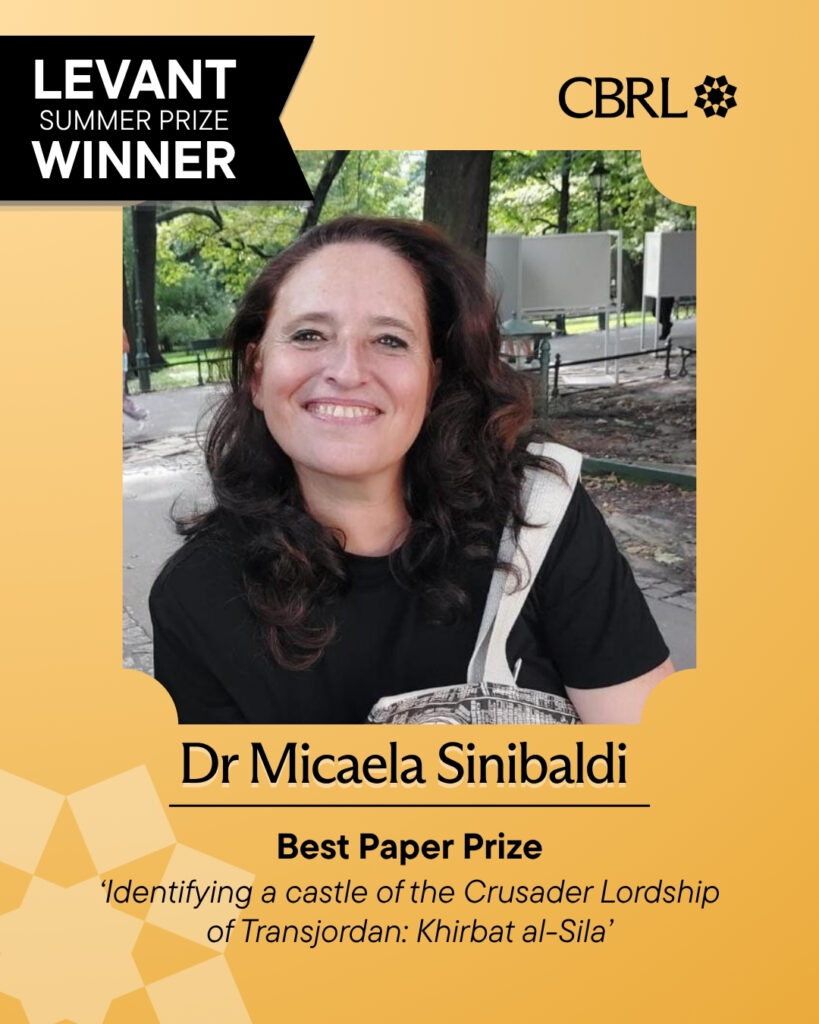
Best Paper Prize Winner
Dr. Micaela Sinibaldi
Identifying a castle of the Crusader Lordship of Transjordan: Khirbat al-Sila
The paper is available to read here
“I am very honoured to have been awarded the Levant Summer Prize. The paper identifies the location of a Crusader castle of major importance mentioned in western and Arabic sources as the site of Khirbat as-Silaʿ in the Tafileh region of Jordan. The identification of the location, long debated by scholars, received solid confirmation with the recent excavations at the site by the Sila’ Archaeological Project. These results increased the already great historical significance of the spectacular site of Khirbat as-Silaʿ, until now better known for earlier historical periods.
I am deeply grateful to the committee members, to the colleagues who contributed with fruitful discussions to this study, and the Department of Antiquities of Jordan, who facilitated research at the site. Above all, I hope that the paper will contribute to increasing the recognition of the historical value of Khirbat as-Silaʿ, and create wider public appreciation and protection of its important archaeological heritage.”
Dr Micaela Sinibaldi is an Assistant Professor at the University of Warsaw in Poland She is the Director of the Sila’ Archaeological Project and of the Karak Castle and Town Documentation Project. After her PhD thesis at Cardiff University entitled Settlement in Crusader Transjordan (1100-1189): a Historical and Archaeological Study, she has co-edited the volume Crusader Landscapes in the Medieval Levant. The Archaeology and History of the Latin East (University of Wales Press, 2016).
Early Career Best Paper Winner
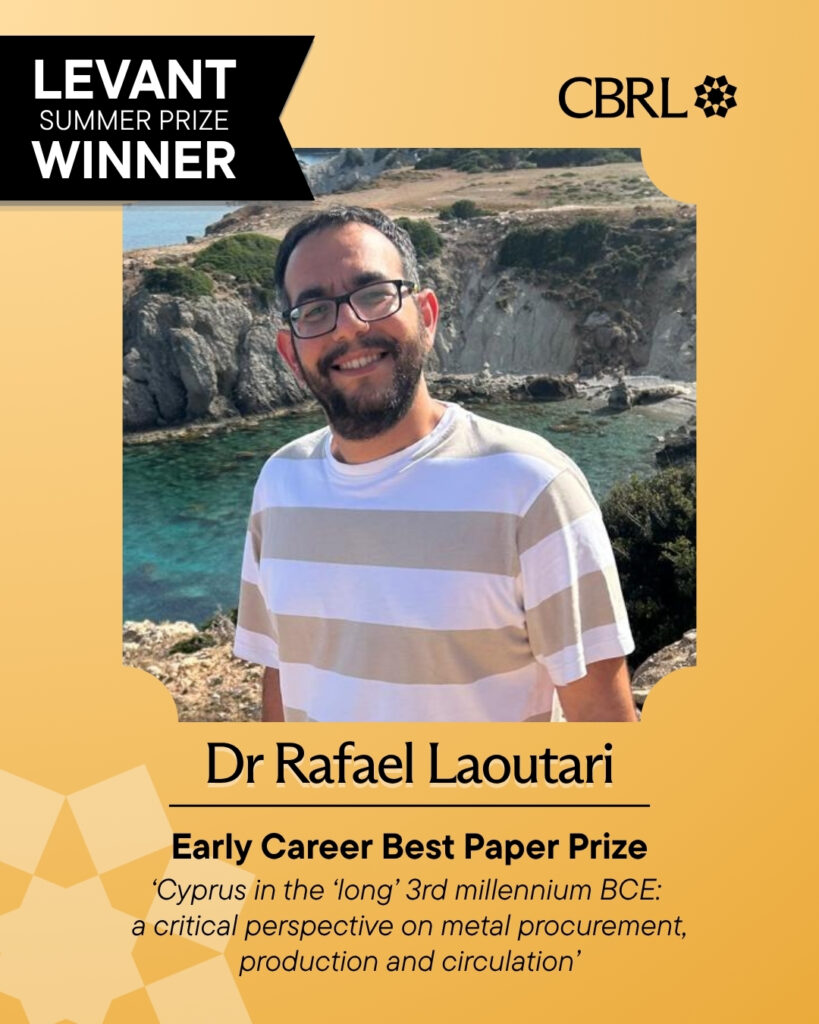
Dr Rafael Laoutari
Cyprus in the ‘long’ 3rd millennium BCE: a critical perspective on metal procurement, production and circulation
co-written with Andreas Charalambous
The paper is available to read here
“We are honoured to receive the 2025 Levant Summer Prize for Early Career Best Paper. This prize recognises an exceptional collaborative experience that achieved to bring together diverse strands of both legacy and newly generated data relating to a specific category of material culture—metal artefacts—to address social questions spanning multiple scales of interactions within and beyond the island of Cyprus during the late 4th and 3rd millennium BCE.
We are deeply grateful to the committee members for recognising the value of this work, and to all the mentors, colleagues and funding bodies who have supported this research. In particular, this study will not have been possible without the generosity and openness of institutions such as the Department of Antiquities, Cyprus, the Fitzwilliam Museum, the McDonald Institute for Archaeological Research (University of Cambridge) and the Archaeological Research Unit (University of Cyprus).
Beyond the new social narratives advanced in this study, this work has made available a large and invaluable dataset that opens up countless opportunities for cross-regional research on connectivity and comparative approaches to metal-related practices across the Eastern Mediterranean and Southwest Asia. We hope that this recognition will encourage other scholars to make similar datasets openly available, setting in motion a process that will lead to more inclusive, representative and collaborative social narratives of the past in this part of the world.”
Dr Rafael Laoutari is a Research Associate at the McDonald Institute for Archaeological Research, University of Cambridge, where his research focuses on the materiality of social interaction in Cyprus and the Eastern Mediterranean during the 3rd and early 2nd millennia BCE. Through his research, he has worked extensively with ceramics, metal artefacts, and other small finds, often contextualised through the dynamic nature of mortuary practices. In addition, Rafael has been involved in numerous excavations and pedestrian surveys in Cyprus and is currently also undertaking collaborative research on Late Prehistoric Morocco. Ultimately, his work centres on bottom-up approaches to understanding social relationships in ranked Mediterranean societies.