

By Charlotte Vekemans, PhD candidate, Middle East North Africa Research Group, Ghent University.
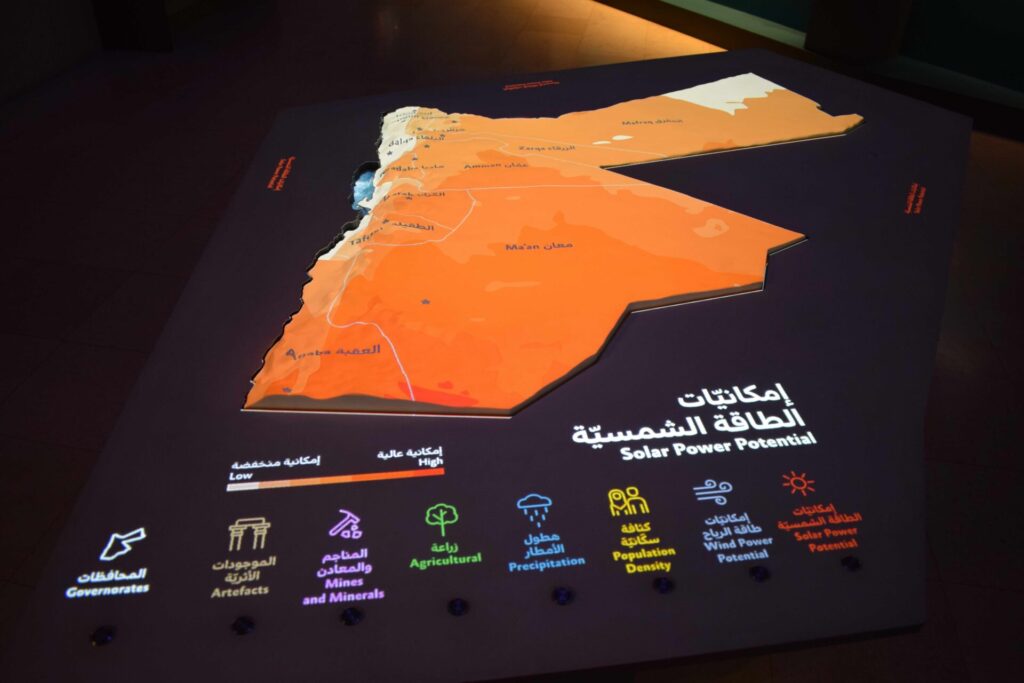
At the centre of the Jordan Museum stands a glowing map, with buttons that allow you to choose information about Jordan (Figure 1) including the potential for non-renewable resources, that will, in the future, light up the country. You can opt to see “solar power” or “wind power” distributed across the Jordanian landscape. The first button, however, lights up “artefacts”, historical remains that pop up in the map and of which replicas are distributed across the new exhibition, which is appropriately called: Jordan Then & Now. Land of Innovation, Continuity and Change. The message of the exhibition is one of Jordanian resourcefulness despite the challenges, and heritage is positioned as one of the resources Jordanians will draw on to power their future. Heritage is particularly relevant for the tourism industry in Jordan, which is a growing component of the national economy, as foreign visitors are drawn by famous sites such as Petra, Jerash, Wadi Rum.
In my dissertation, I explore how heritage has become such a crucial resource for development projects in Jordan, and how it has become possible for Jordanian and foreign development workers to insert heritage into the economy as if it were solar or wind power. I look at how heritage is used to power political projects as well as economic growth and how it came to take a instrumental position in US, Japan and EU member states’ development work. These are questions that are not exclusive to Jordan – as heritage is increasingly leveraged in development work across the globe.
With the support of CBRL and the Andrea Zerbini grant, I continued my ethnographic and historical research in May/June 2025 to trace how heritage functions through the construction of itineraries: routes that connect particular sites into circuits of value. In Jordan, the insertion of heritage into the tourism economy depends largely on these itineraries. Development projects seek to expand existing routes to include new sites, encouraging visitors to spend more time, and money, in the country – but these routes are not new. They have long histories linking back to the 19th-century explorations of Western travellers such as Ulrich Seetzen and Henry Baker Tristram, who journeyed through the region in search of traces of sites mentioned in the Bible and those forming part of the Roman Empire.
My analysis of their itineraries shows how their movements were conditioned by the power of the local Bedouin tribes and Ottoman infrastructure. The earliest explorers often travelled in secret and were entirely dependent on local knowledge of the landscape to locate interesting ruins and antiquities. Northern Jordan was often included in early explorations as it is on the axis between Jerusalem and Damascus. Middle and Southern Jordan were less traversed; here, the Ottoman state had very little power, travel infrastructure was limited and under the control of Bedouin tribes. The explorers tried to establish their own power over the landscape by minimizing local knowledge and instead favouring an understanding of the past that foregrounded the history they considered to be their own.
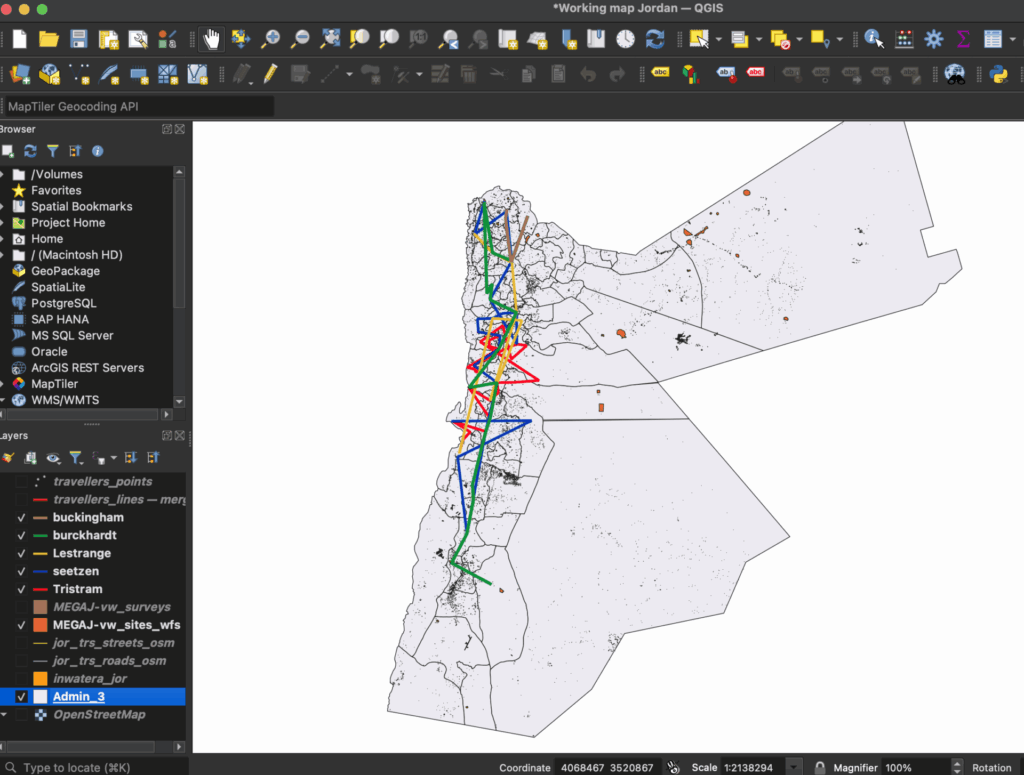
These early itineraries left a lasting imprint on the heritage map of Jordan. The routes and sites identified by these explorers were later developed as heritage projects and form part of the tourism circuits, creating different narratives depending on the funding source.
To analyse these shifting connections, I draw on the imagery of desire lines: unplanned paths worn into the landscape by repeated use, often creating a shortcut where paved roads take longer. These pathways are not intended by planners, but neither could they exist without their interventions. They are formed by and in reaction to existing paths: they are neither wholly official nor entirely informal, existing through continuous negotiation and movement.
In my research, desire lines serve as a metaphor for the ways heritage connections are formed, contested, and transformed. Inspired by anthropologist Anna Tsing’s work on “unruly edges” and geographer Doreen Massey’s understanding of space as dynamic and relational, I use the concept to resist static or singular interpretations of heritage. Just as desire lines shift with each season, heritage networks evolve through everyday practices, negotiations, and resistances.
In Madaba, where I conducted the majority of my ethnographic fieldwork, the official, paved roads that allow tourists to move through the city, assemble the heritage sites in such a way that they support the political projects of the monarchy and foreign allies whose development projects have reconfigured the city. These roads were historically formed out of contestation: they emerged from previous informal connections – or desire lines as I imagine them — made by 19th century Western explorers and colonial agents, who were dependent on local guides and tried to make the landscape their own. These connections formalized over the course of the late 20th century and became particularly entrenched in the Madaba landscape through heritage development projects of the World Bank and USAID. Through legislation, city refurbishment, grids of heritage selection, and persistent repetition out of habit – narratives of Christian, Byzantine heritage came to dominate the city. These narratives functioned materially in support of the political project of the monarchy and its international allies: to legitimize the Jordanian position as peace-negotiator in the Middle East and stable ally of the West.
But through the desire lines feeding these heritage narratives, runs also contestation. Christian families in Madaba have drawn on the entrenched tourism itineraries to solidify their position while equally opposing the government policies. Business entrepreneurs I spoke with critiqued the government’s approach to heritage while equally playing their part in its constitution. The itineraries never supported only a single political project, instead connecting people, places, and pasts in different, open-ended ways at the same time. Aside from the entrenched itineraries, my interlocutor’s attention to the discarded past allowed me to see how fragmentary histories equally supported radically different visions of the future.
By tracing the histories of heritage itineraries—from 19th-century explorations to 21st-century development projects—we can better understand how heritage continues to shape the Jordanian landscape. The concept of desire lines reminds us that these trajectories are not fixed: they are continuously remade through the actions of planners, funders, and ordinary people alike. Heritage, then, is not a static resource waiting to be extracted. It is ongoing work and contestation, work that connects past, present, and future through the movement of people, ideas, and power.
 Charlotte Vekemans is a PhD candidate at the Middle East North Africa Research Group, Ghent University. Her research explores the political economy of heritage development in Jordan.
References
Massey, Doreen B. For Space. London: Sage, 2005.
Tsing, Anna Lowenhaupt. The Mushroom at the End of the World: On the Possibility of Life in Capitalist Ruins. Princeton, NJ: Princeton University Press, 2015
Vekemans, Charlotte. 2025. “Jordan : Pursuing Legitimacy and Economic Growth through Heritage Development.” In Political Economy, Power, and Cultural Heritage in the Arab World, edited by Hicham Alaoui and Robert Springborg, 45–69. Boulder, Colorado: Lynne Rienner.
The views expressed by our authors on the CBRL blog are not necessarily endorsed by CBRL but are commended as contributing to public debate.