





Qasem Abu Harb, our Senior Archivist at The Kenyon Institute, talks about the The Cairn of Haniʾ Inscribed Stones from Northern Jordan and how they become an act of rememberence.
Among the remarkable treasures preserved in the CBRL Kenyon Institute Archive is an extensive collection of The Illustrated London News, spanning the years 1930–1971. These historic issues document important archaeological discoveries, cultural landscapes, and historical narratives from across the Middle East.
This month, we revisit a significant archaeological record from northern Jordan: The Holy Man of Dark Age Jordan, and the Cairn His Kinsmen Built and Inscribed, originally published in The Illustrated London News in October 10, 1953. The photographs document the Cairn of Haniʾ in the Mafraq region and capture excavations led by G. Lankester Harding, then Director of Antiquities of Jordan. The publication reflects a formative period in Levantine archaeology, when field excavation, photography, and epigraphic study were increasingly combined to document the desert landscapes and ancient communities of the eastern Levant.
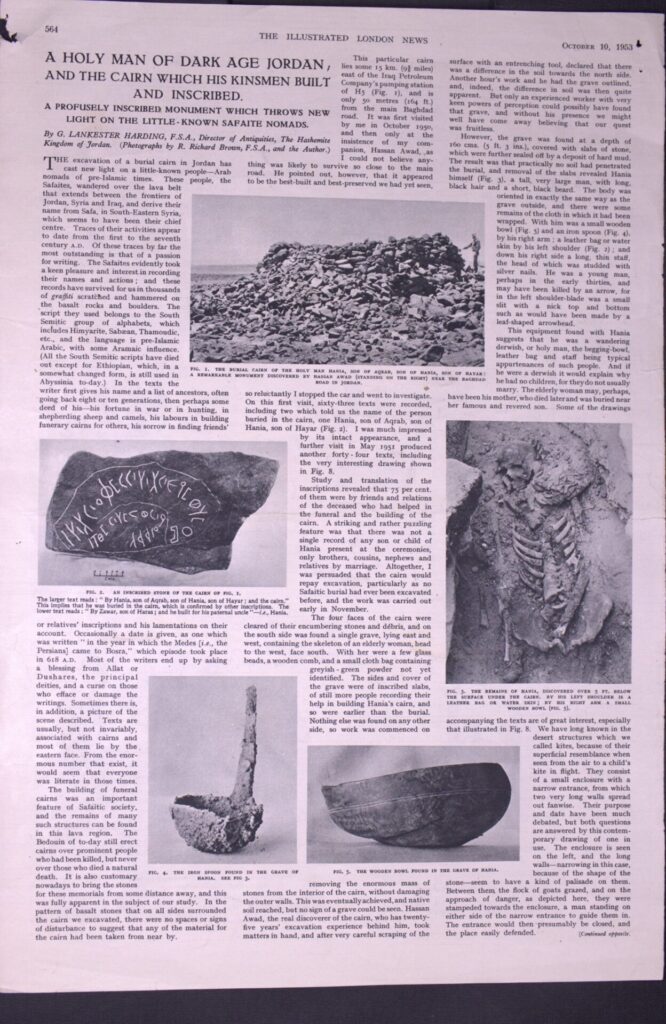
The first image above presents the Cairn of Haniʾ within its wider desert setting in northern Jordan. The monument appears as a low stone-built mound embedded in the basalt landscape characteristic of the Mafraq region. This type of structure belongs to a long tradition of cairn burials across north-eastern Jordan, often associated with nomadic and semi-nomadic communities.
Excavations led by Harding demonstrated that such cairns were not merely simple accumulations of stones placed over burials. Rather, they were carefully constructed monuments that were revisited and modified over time. The archaeological context suggests that the cairn formed part of a wider funerary landscape shaped by repeated human activity and memory-making practices.
Viewed within its environmental setting, the cairn emerges not only as a burial monument, but also as a landmark within a mobile desert world, where places of burial functioned as points of orientation, remembrance, and social identity.
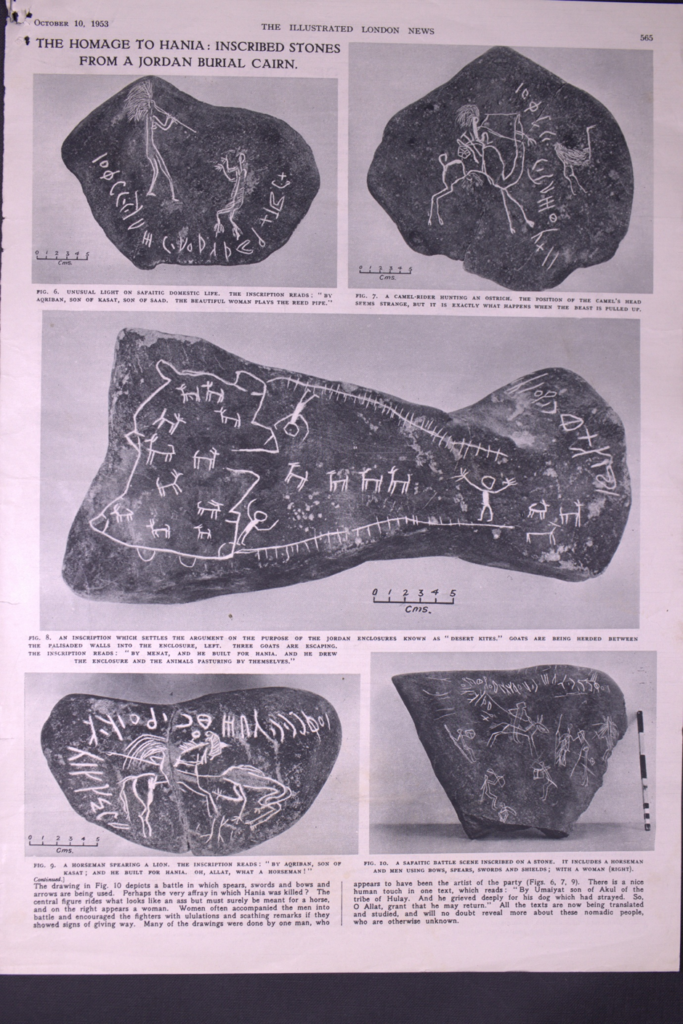
The image above shifts from landscape to detail, focusing on the inscribed stones recovered from the cairn. These basalt stones bear Safaitic inscriptions alongside occasional simple figural drawings carved directly into the rock surface.
The inscriptions are brief yet deeply expressive. Many include personal names, genealogical references, and statements of mourning or remembrance. Several follow commemorative formulas known from other Safaitic inscriptions, particularly expressions of grief for named individuals.
Unlike formal monumental inscriptions, these carvings represent personal acts of engagement with the site. Each inscription preserves a moment when an individual stopped at the cairn and recorded memory directly into stone. Together, the inscriptions suggest that the cairn functioned as a shared ritual and commemorative space, repeatedly visited by different individuals and groups over time.
From Monument to Memory
Viewed together, the two photographs create a compelling archaeological narrative. The first establishes the cairn as a physical structure within its desert landscape, while the second reveals its deeper role as a repository of memory, identity, and mourning.
The Cairn of Haniʾ therefore represents both a funerary monument and a living memorial site, continually reactivated through repeated acts of inscription and visitation. The 1953 publication preserves not only the excavation itself, but also a rare encounter with the expressive culture of ancient desert communities in northern Jordan.
Archaeological and Scholarly Importance
The publication holds significance both archaeologically and historiographically. It belongs to an early phase of Levantine field archaeology when interdisciplinary approaches to excavation and documentation were beginning to take shape.
Equally important, the discovery contributed to the growing study of Safaitic inscriptions, highlighting the importance of desert epigraphy for reconstructing the social history of pre-Islamic northern Arabia and Jordan. For the Department of Antiquities and the scholars involved, the cairn offered access to voices and personal expressions that rarely survive in conventional historical narratives.
Reflection
The Cairn of Haniʾ reminds us that archaeology is not solely the study of structures and artefacts, but also the study of remembrance. Through brief inscriptions carved into basalt, ancient individuals recorded grief, identity, kinship, and presence within the landscape itself.
Today, the photographs published in 1953 remain both archaeological documentation and historical artefacts, preserving a quiet yet enduring dialogue with ancient voices across time.