

From 19–24 October 2026, staff from CBRL’s Amman and Jerusalem offices travelled to London for a week of archival workshops, institutional visits and professional exchanges, as part of our Al Tajir Trust grant to digitise the Architecture of Islamic Jerusalem archive in collaboration with the Palestine Exploration Fund
The week focused on strengthening collaboration with the Palestine Exploration Fund (PEF), advancing work on the Architecture of Islamic Jerusalem archive, and exploring shared approaches to archival preservation, digitisation and accessibility.
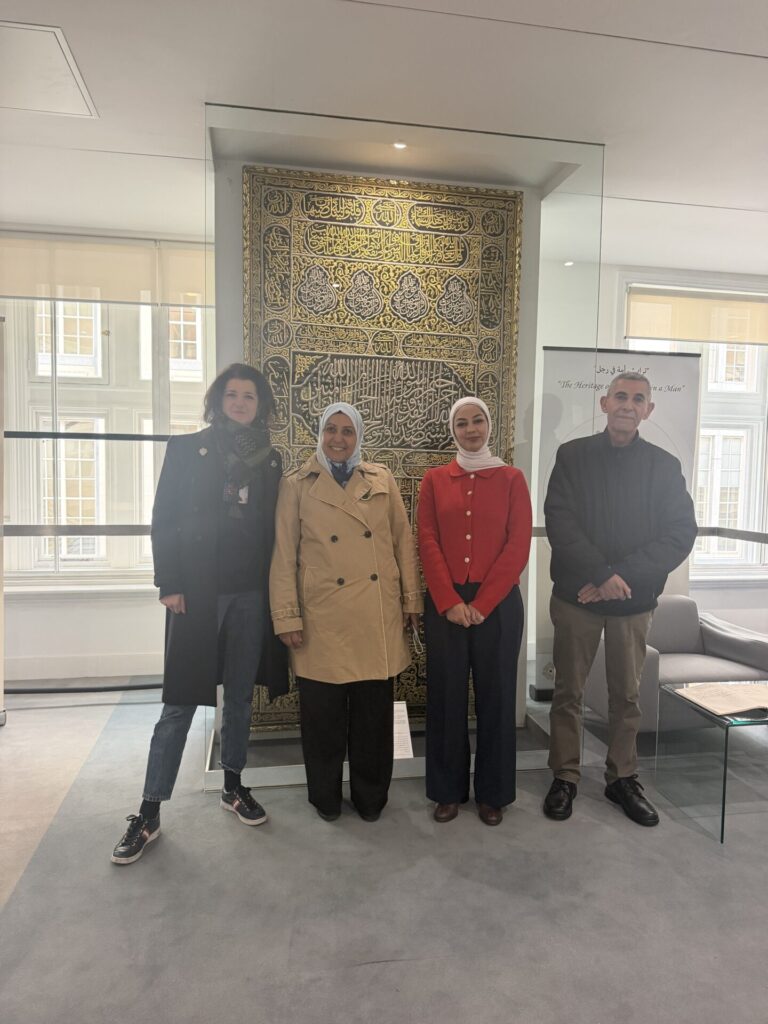
The team included Qasem Abu Harb, Senior Archivist in Jerusalem; Rudaina Al-Momani, Senior Librarian and Researcher in Amman; and Eman Shahin, Archive and Library Officer in Amman. Alice Lubbock, CBRL’s UK Archives and Repository Manager, organised and facilitated the workshop which was held with the PEF at their premises in Greenwich in London.
Thanks to the generous support of the Al Tajir Trust; Ottoman Jerusalem and Mamluk Jerusalem are now freely available online through JSTOR. Following the earlier digitisation of the Mamluk Jerusalem volumes, the digitisation and online availability of Ottoman Jerusalem marks a further step in improving access to these important publications and supporting research into Jerusalem’s history.
Workshop at the Palestine Exploration Fund (20–21 October)
A two-day workshop at the Palestine Exploration Fund (PEF) was dedicated to planning the next stages of the Al Tajir Trust-funded project work relating to the Architecture of Islamic Jerusalem archive.
The workshop brought together colleagues from CBRL and PEF to exchange expertise, review archival requirements, and establish priorities for the next phase of the project. Discussions focused on developing an archive reference numbering system and digitisation metadata, as well as harmonising approaches to the organisation, description and management of archival materials across the three locations. The team also looked at coordinating digitisation workflows as archival materials are being digitised simultaneously at CBRL’s Kenyon Institute in Jerusalem, Amman Institute, and the Palestine Exploration Fund (PEF) in London, where the work is being undertaken by PEF colleague Alessandra Guadagnini.

The team had the opportunity to examine the PEF’s Architecture of Islamic Jerusalem archive and meet Archie Walls, one of the architects involved in the original project to document the Islamic architecture of Jerusalem. A wider tour of the PEF introduced the team to other British School of Archaeology in Jerusalem (BSAJ) archival collections and provided an opportunity to explore how these collections are managed, conserved and made accessible.

Qasem Abu Harb and Eman Shahin presented an overview of CBRL’s archival collections, introducing the range of historical materials held across both locations and providing an opportunity to exchange knowledge and discuss archival practices with PEF colleagues.
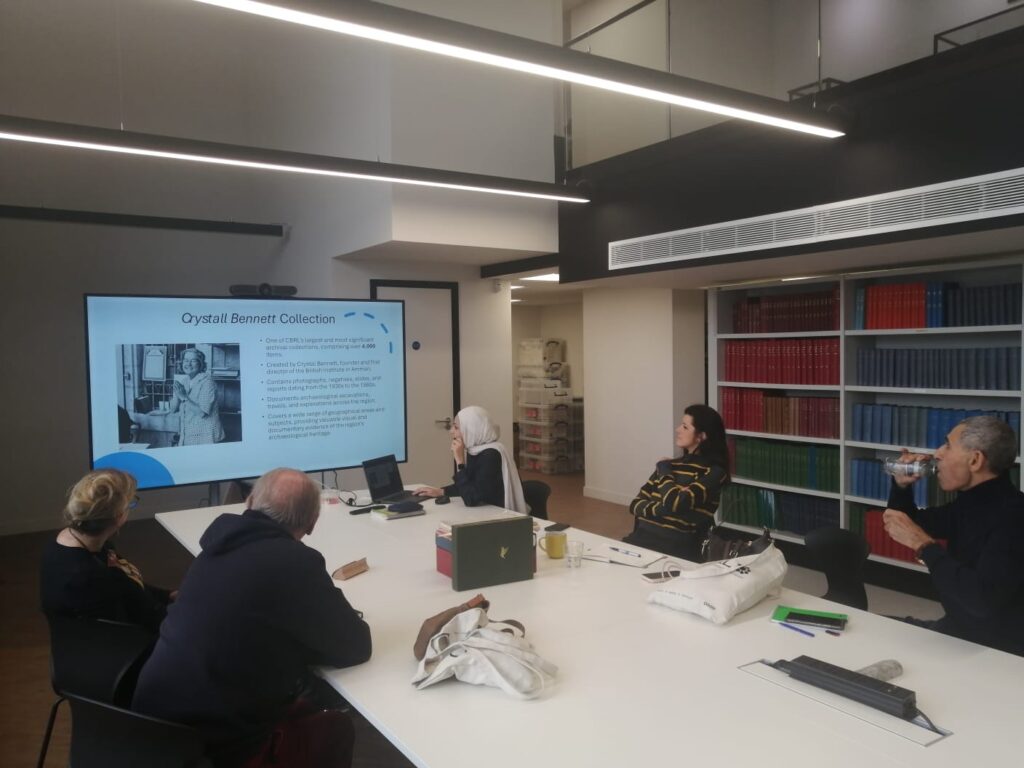
The team reviewed project timelines, targets, and the volume of work required to complete the remaining activities by the end of April 2027.
Institutional Visits and Knowledge Exchange (21–23 October)
The team also visited various cultural and research institutions in London, so that they could learn about different approaches to managing collections, digital resources and public engagement.
The first of these visits took the Archive Team to the Painted Hall on 21 October, accompanied by London colleagues Miranda Ludden and Carla Grauls. The Painted Hall is the opulently decorated grand hall inside the Old Royal Naval College at Greenwich, painted between 1707 and 1726 by Sir James Thornhill and known as ‘the UK’s Sistine Chapel’.
Victoria and Albert Museum (V&A) – 22 October
The team visited the Victoria and Albert Museum, exploring the Jameel Gallery of Islamic and Middle Eastern art, as well as the museum’s Cast Courts and Photography galleries. The visit offered an opportunity to engage with its wider collections and approaches to present material culture. Seeing both the V&A’s photography collections and its breadth of Middle Eastern material added to our sense of anticipation for one part of the Al Tajir grant work – that of collating all the photographic material by K.A.C. Creswell, the British architectural historian and photographer of Islamic monuments, from this project, and digitally exhibiting it alongside similar Creswell collections from Harvard University and the Ashmolean Museum. This project is spearheaded by a curator at the V&A, who has been cataloguing that museum’s huge collection of Creswell photography of Islamic architecture.
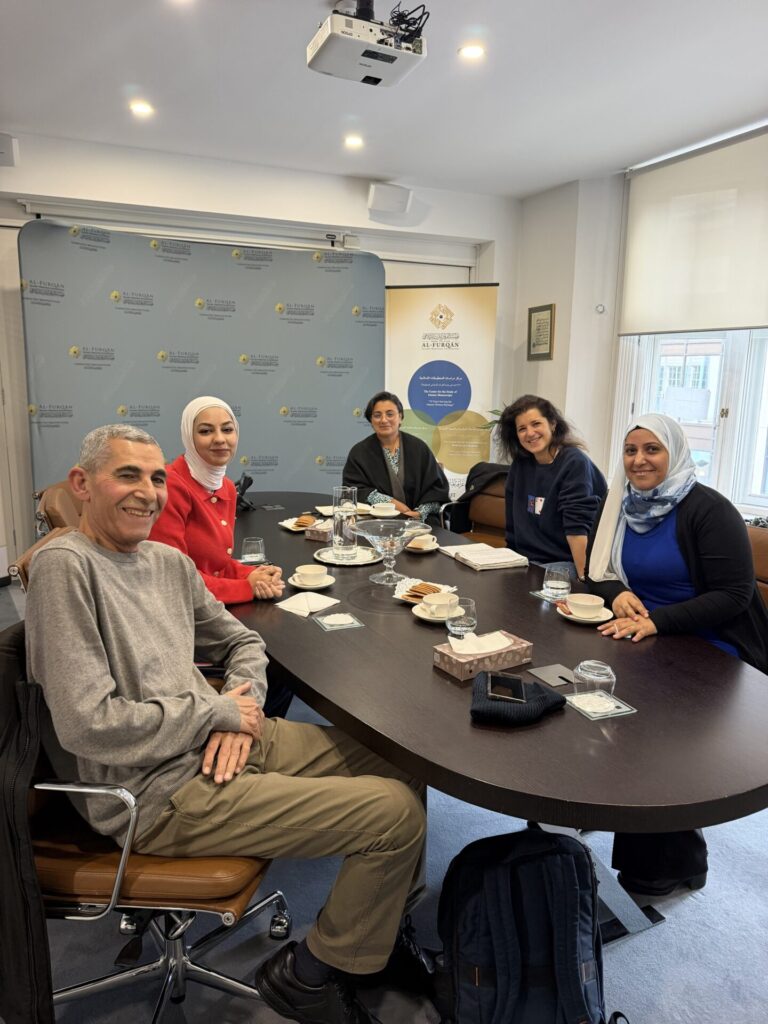
Al-Furqan Foundation – 22 October
The team visited the Al-Furqan Islamic Heritage Foundation and met Ms Karima Benaicha, responsible for Data Mining and Data Processing, and Ms Linda Antuan, responsible for Office and Operations.
The meeting was to discuss potential areas of future collaboration between CBRL and Al-Furqan in relation to Islamic collections and the exchange of professional knowledge and expertise, particularly around English-to-Arabic and vice versa translation of digital records and searchable text, for Al Furqan’s archive and library contains a vast collection of over 15,000 printed Islamic manuscript catalogues from more than 70 countries, which is a unique and invaluable bibliographic resource.
The Mosaic Rooms – 23 October
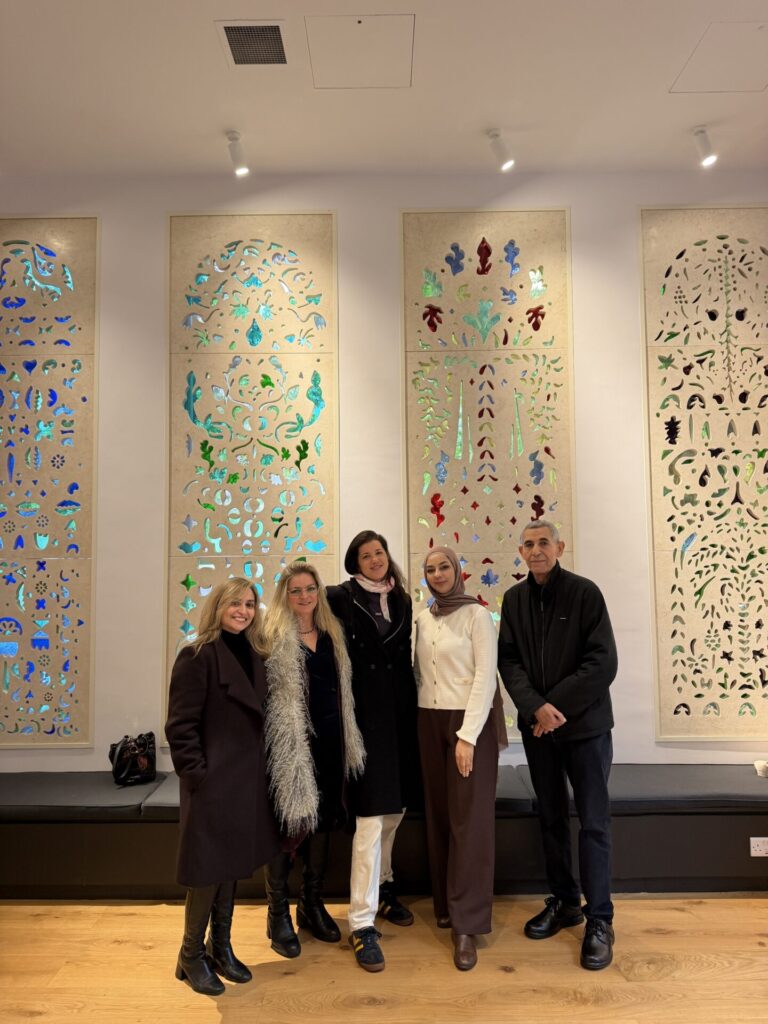
A further institutional visit, accompanied by PEF colleagues, took place at The Mosaic Rooms, where the team met Angelina Radaković, Head of Curatorial. Palestinian artist Dima Srouji, a trustee of the PEF, had installed colourful glass window panels in the entrance hall, where we had an introduction from Angelina about the current exhibitions, future plans, and the recent refurbishment of the Mosaic Rooms. The exhibition on view recasts the gallery as a space for listening, communing and sonic experimentation, including the strands ‘From–To’, an installation by Gaza’s Dahaleez Collective; ‘Common Frequencies’ by El Warcha Collaborative Design Studio; and a rotating programme of artist takeovers. The visit offered a useful insight into how a small London gallery is curating contemporary Palestinian and SWANA work, and prompted wider conversations about future collaboration, and the display of archival material.
Academic Engagement: Book Launch at the University of Notre Dame – 23 October
Alongside these activities, the CBRL Archive Team attended the London launch of Peasant Agriculture in the Jerusalem Hills by Lucjan Turkowski, edited by Dr. Carol Palmer.
The event was co-organised by CBRL and the Palestine Exploration Fund (PEF) and took place at the University of Notre Dame, London.
The book explores Turkowski’s documentation of Palestinian rural life during the final years of the British Mandate, highlighting traditional agricultural practices, local knowledge, material culture and the social relationships that sustained rural communities.
The event provided an opportunity for the team to engage with colleagues and researchers and to celebrate a publication that contributes to documenting and preserving an important aspect of Palestine’s social and agricultural history.


Looking Ahead
The week in London offered valuable opportunities for professional exchange, institutional engagement and the development of future collaboration. The workshop at the PEF helped establish priorities for the next stages of work on the Architecture of Islamic Jerusalem Project archive, while discussions across the programme highlighted the importance of consistent archival practices, sustainable digitisation workflows, collections care and accessibility.
The visit also reinforced the value of collaboration across CBRL’s offices in Jerusalem, Amman and London, supporting a shared approach to preserving, documenting and making its dispersed archival collections accessible for future research.