

By Professor Joanne Clarke, School of History and Art History, University of East Anglia
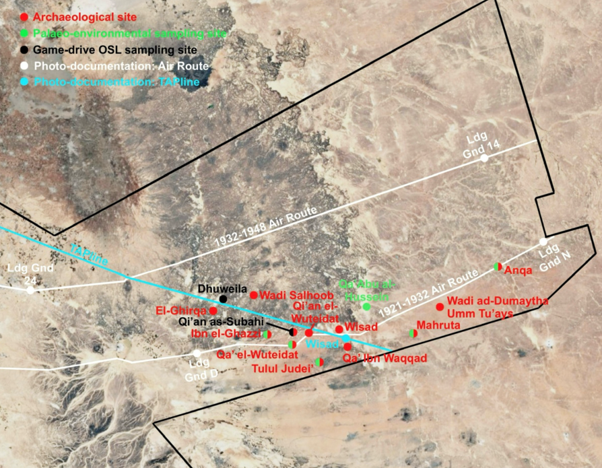
In autumn 2024, Dr Tom White, a snail specialist from the Natural History Museum, came along to the Eastern Badia Archaeological (EBAP) Project’s annual field season, to do some environmental sampling of qi’an, the shallow sandy areas (playas) that dot the Black Desert (harra) of eastern Jordan. (Figure 1)
Prior to Tom joining the 2024 field season, preliminary palaeoclimatic and palaeoenvironmental work indicated that the region during the early Holocene was better-vegetated and probably wetter than today; with the desert able to support significant human and animal populations in a region that is currently largely uninhabited.
We wanted to test preliminary results we had obtained from an initial study of terrestrial and freshwater snails from Wisad Pools, undertaken by Tom and another colleague, Julian Andrews. This study turned up an earthworm-eating semi-slug at Wadi al-Qattafi suggesting significant rainfall, at least at the western edge of the Badia around 8000 years ago, while pollen at Wisad Pools, located on the eastern edge of the Badia, indicated contemporary open stands of oak and wild almond, probably with willow and bullrush around seasonal water sources. Not far from the pools, this environment gave way to more arid conditions. On this basis our working hypothesis was that the entire region was wetter than today. This was clearly too simplistic; we needed more soil samples, more snails, more pollen and more dates, so Tom went out into the desert to get more data.
Until 2024 all of our evidence for environmental conditions around 8000 years ago came from settlements. This time we aimed to extend our study by sampling the qi’an. Even today these fill with water during periods of heavy rainfall, bringing growth of wildflowers and grasses, and the mobile herders, whose ways of life – whilst continuously evolving – echo those of previous generations.
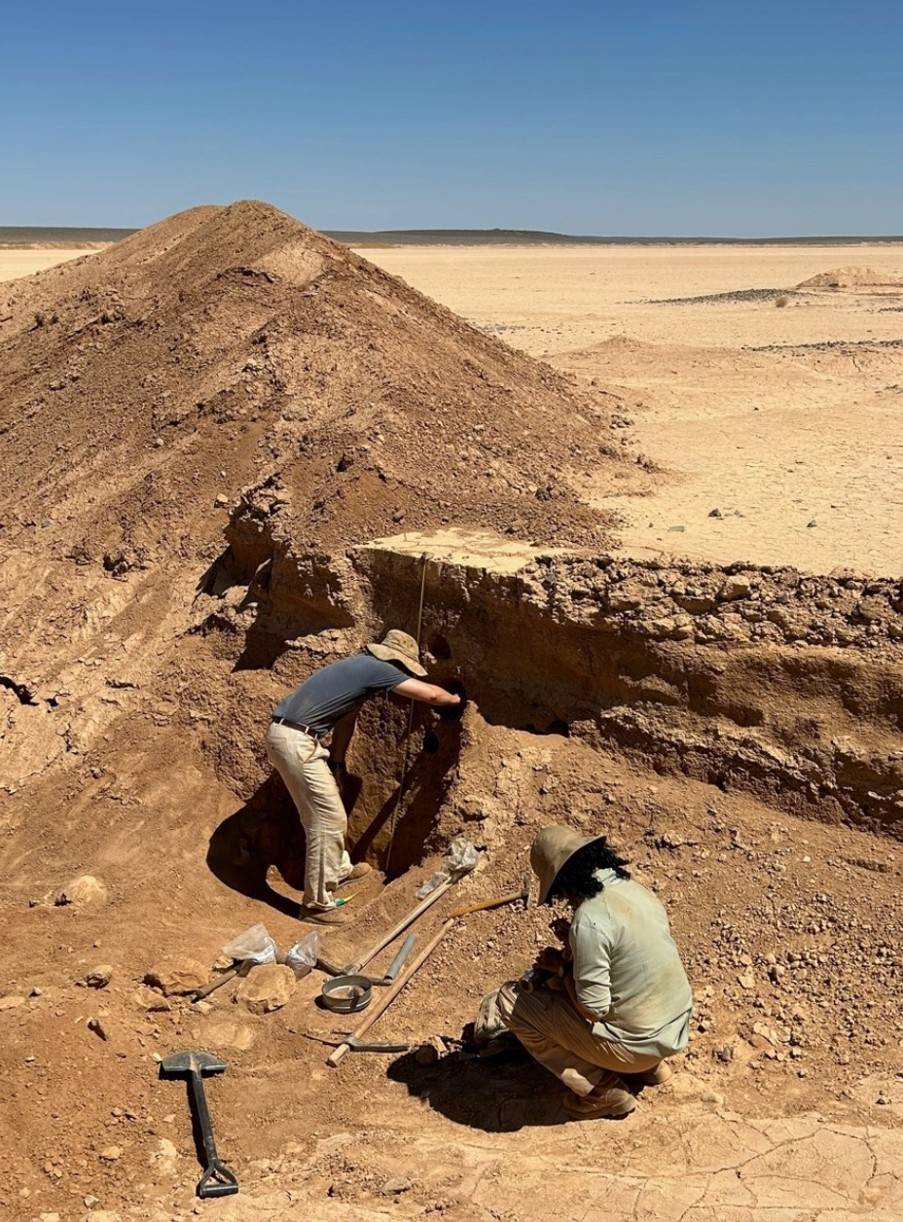
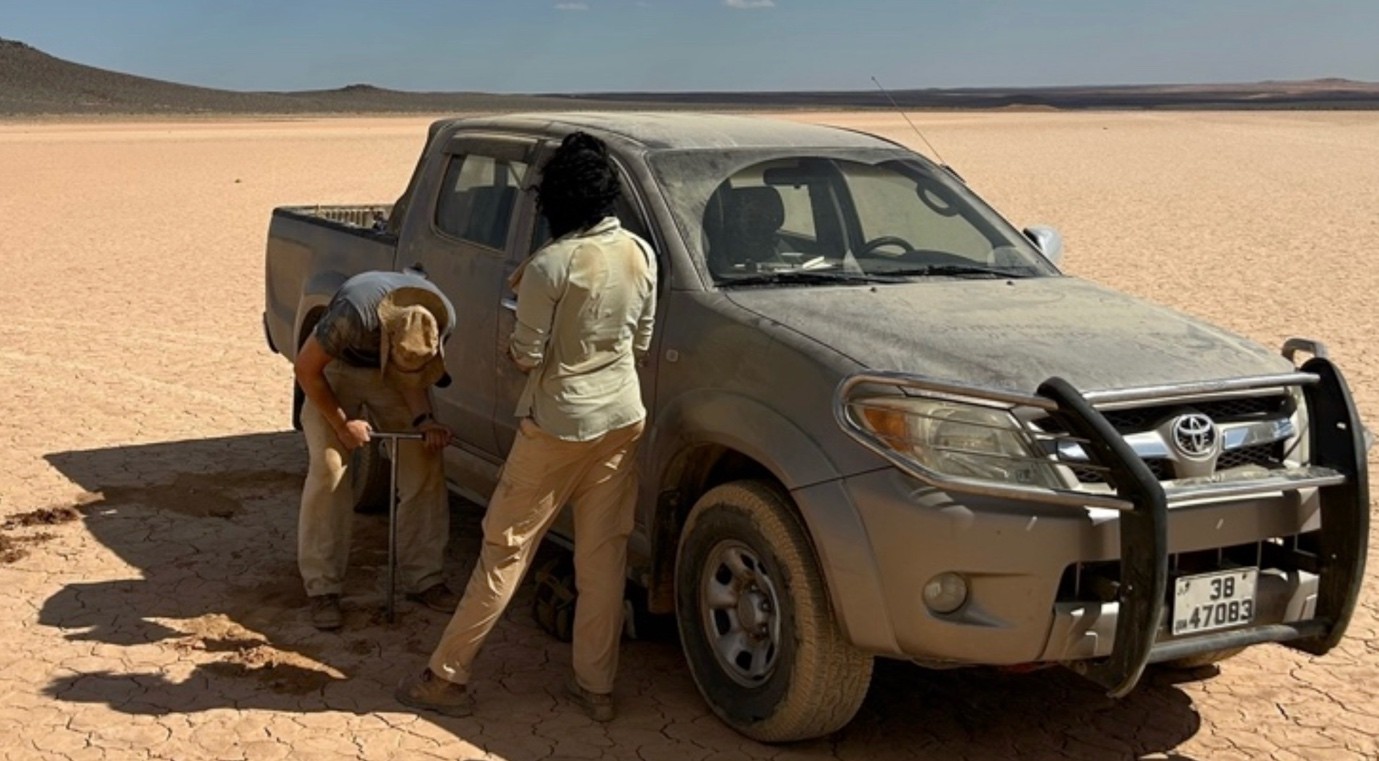
The heavy rains in the desert between winter and late spring have led the Jordanians to invest in water security by mechanically excavating large artificial ponds, known colloquially as mahafir, for the collection and storage of surface run-off water. Such activity routinely exposes large, standing sections of sediment trapped within qi’an which we were able cut back to pristine surfaces and collect our sediment samples (Figure 2). We also tried to core the qi’an using a hand auger, but this proved to be extremely difficult owing to the compacted nature of the sediment (Figure 3). In the end we extracted 29 bulk soil samples, three 2cm-interval sediment columns, and five OSL-dating samples, which are now undergoing analysis.
In early 2025, we sent bags of sediment from multiple sites to the University of Nottingham for pollen analysis, and OSL-dating samples from Anqa and Wisad (Figure 1) sent to Durham University.
Much to our surprise, given that previous pollen analysis from locations close to ours had yielded useful early Holocene results, there was not much pollen in what was analysed and it was extremely delicate. Even with very gentle treatment, sediment removal was difficult, with mineral material obscuring the pollen.
We had expected dates in the early Holocene, contemporaneous with the later Neolithic occupations of the region and with the dates obtained from previous published pollen samples, but we were completely surprised by the results. Instead of dating to the early Holocene as expected, the dates for the sediment from both Anqa and Wisad were around 60,000 years old. What we thought to be poorly preserved Holocene pollen was instead, well preserved Pleistocene pollen!
The environmental work has expanded our understanding of the formation of qi’an and the Jordanian Black Desert. Our previous assumption that qi’an formation was mostly a process that happened during a much wetter early Holocene has been shown to be incorrect. We now understand that the formation of qi’an happened during alternating periods of humid and arid conditions that led to the accretion of sediment during the wetter periods only to be degraded and deflated during periods of aridity. And so what we must assume is a dynamic environment that went through significant change over 60,000 years, and probably considerably longer. How humans adapted to these changing conditions continues to be the focus of the project.
A hypothesis we are currently testing is that the playas adjacent to large late-prehistoric settlements experienced atypically high levels of Holocene infilling with sediment. This might have been linked to the destabilisation of ground surfaces as a result of woodcutting and overgrazing following the hunting-herding transition by 9000 years ago. In such a scenario, landscapes more distant from settlements may have been much more stable as they will not have been anthropogenically altered. Another priority is to continue to assess the palaeo-environmental potential of newly discovered water-collection features cut into qi’an adjacent to no less than four Neolithic sites.
This work has not been easy. Methodological issues have constantly arisen which have tested our ingenuity. In the first instance, the pollen was too degraded to undertake standard pollen analysis and instead we had to send away a dozen samples for special treatment with hydrofluoric acid. The very early OSL dates led us to take the decision to analyse fewer pollen samples while increasing the number of OSL dates, in order to understand whether older sediments are a feature of qi’an located further away from settlements.
We are in the process of acquiring another series of OSL dates currently and will keep CBRL posted as the new dates when the pollen analysis comes in. We continue to develop new methods to meet the environmental challenges of this region. Although we are excited by the complex paleo-environmental picture that is emerging, this environment does not give up its secrets easily and we continue to have to evolve alongside it.
Biography
Professor Joanne Clarke joined the University of East Anglia in 2001. Her research interests include societal responses to climatic changes during the early and mid-Holocene in the Near East and North Africa and the impacts of future climate change on heritage in Africa. She has directed archaeological field projects in Gaza, Cyprus and the Western Sahara culminating in a book published in 2018.
The views expressed by our authors on the CBRL blog are not necessarily endorsed by CBRL but are commended as contributing to public debate.