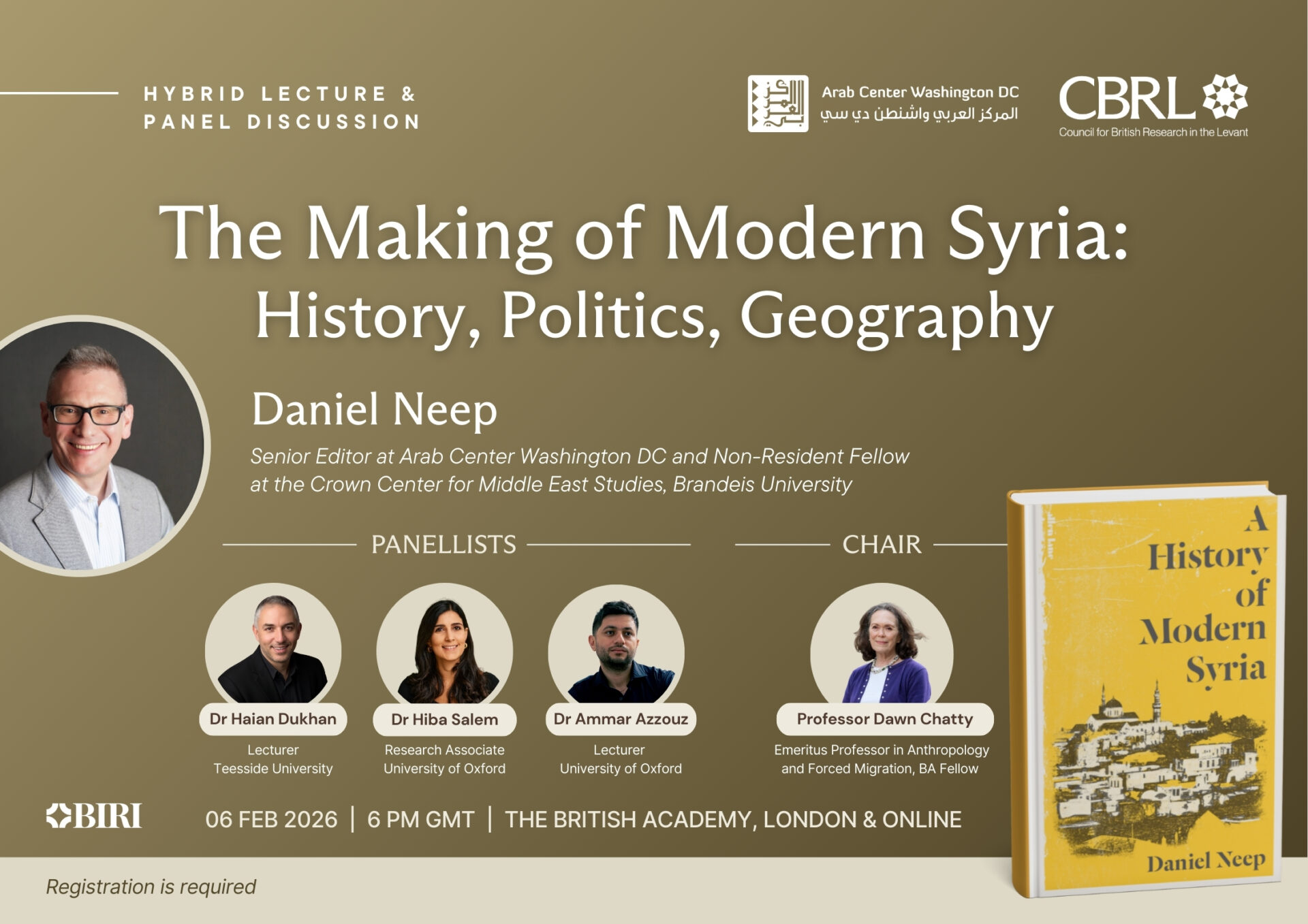


CBRL is pleased to present a special hybrid lecture and panel discussion on The Making of Modern Syria: History, Politics, Geography to take place at The British Academy and online on Friday 6th February from 6pm UK time.
Daniel Neep will present his new book The Nation Belongs to All: The Making of Modern Syria.
Modern Syria has seen violence, repression, and autocracy, suffering through tragedy after tragedy over the past century. Yet the history of Syria is not just a tale of dictators and generals. From the 1800s to the 2020s, the Syrian people have engaged in a passionate struggle for justice, equality, and a better future.
Whether fighting for national independence from French colonial rule, battling local landowning elites to share the country’s wealth, or rising up against the Assad regime, the Syrian people have fiercely clung to their right to live with respect and dignity. Theirs is a story of protest and perseverance in the long fight to reshape the political destiny of their nation.
Daniel Neep’s new book, A History of Modern Syria (Allen Lane, 2026), explores how Syrians have navigated these events over the years. Never losing sight of the fates of ordinary people, the book provides a comprehensive account of how a nation born in conflict nevertheless sustained a rich, complex, and diverse society that, after the fall of the Assad regime, will chart its own path into the uncertain future.
Professor Dawn Chatty will Chair the discussion, and will be joined by panellists: Dr Haian Dukhan, Dr Hiba Salem and Dr Ammar Azzouz.
Biographies of speakers:
Daniel Neep is Non-resident Fellow at the Crown Center for Middle East Studies at Brandeis University and Senior Editor at Arab Center Washington DC. He has taught Middle East politics at George Washington University, Georgetown University, and the University of Exeter, and was previously Syria research director with the Council for British Research in the Levant. He is the author of Occupying Syria under the French Mandate (Cambridge University Press, 2012) and articles in journals including International Affairs, Journal of Democracy, New Political Economy, and Journal of Historical Sociology.
Professor Dawn Chatty (Chair) is Emeritus Professor in Anthropology and Forced Migration and former Director of the Refugee Studies Centre, University of Oxford, United Kingdom. She is also Fellow of the British Academy. Her research interests include coping strategies and resilience of refugee youth; tribes and tribalism; nomadic pastoralism and conservation; gender and development; health, illness, and culture. She has worked with nomadic pastoral groups in Lebanon and Syria since the mid-1970s and extended her research to Oman in 1979. She has continued to work with these communities and has engaged in advocacy for the rights of these people to remain mobile and to resist forced settlement. In 1995, when she joined the Refugee Studies Centre at the University of Oxford, she began an additional line of scholarly inquiry, the coping strategies and agency of refugee youth in prolonged conflict. She has worked with Palestinian youth in the five UNRWA field sites: Lebanon, Syria, Jordan, the West Bank and Gaza. She has also worked with Sahrawi refugee youth in Algeria and Spain and Afghan refugee youth in Tehran and Mashad, Iran. She is currently working with displaced Syrians in the neighbouring countries of Syria, Turkey, Jordan, and Lebanon.
Dr Haian Dukhan is a Lecturer in Politics and International Relations at Teesside University and a Fellow at the Centre for Syrian Studies, University of St Andrews. He is the author of State and Tribes in Syria: Informal Alliances and Conflict Patterns (Routledge, 2019) and co-editor of Spoils of War in the Arab East: Reconditioning Society and Polity in Conflict (Bloomsbury, 2024). His research focuses on the international relations of the Middle East, with a particular emphasis on the role of non-state actors in armed conflicts. His work has appeared in the International Journal of Middle East Studies, Nations and Nationalism, Small Wars and Insurgency, and others. He has also authored multiple policy reports for USAID, the Konrad Adenauer Foundation, the Middle East Institute, and others on issues related to sectarianism, extremism, and forced migration. Previously, he taught politics and international relations at the universities of Leicester, Edinburgh, and Queen Mary University of London, and held research positions at the Central European University in Austria and Roskilde University in Denmark.
Dr Hiba Salem is a Research Associate at the University of Oxford. Her research draws on extensive fieldwork with Syrian young people who have grown up in displacement, examining how aspirations are imagined and lived amid social, economic, and political precarity. Her work explores how young Syrians build notions of future-making and belonging in exile, and more recently, how they navigate questions of return to Syria. She is currently writing her monograph, The Politics of Education and Hope in Forced Migration: Journeys of Syrian Young People Across the World, which recently won the OUP First Book Prize.
Dr Ammar Azzouz a Lecturer and a British Academy Research Fellow at University of Oxford. His research focuses on destruction and reconstruction of cities, cultural heritage and art in exile. He is the author of Domicide: Architecture, War and the Destruction of Home in Syria, published by Bloomsbury in 2023. He has written for a wide range of platforms including the New York Times, Financial Times and the Guardian.
Registration:
Book your place in person before Monday 26 January by emailing: [email protected]
Book your place online via zoom registration here.